
Blog
Autonomy instead of authority: how to lead a team that decides for itself
In short: Autonomy is not a switch you flip, it is a path. You hand over one task at a time, from telling via selling and participating to a full handover, and you build the framework that allows decisions and mistakes. The bottleneck is often not your team's competence but your own ability to let go.
In our workshops, we are often asked how leaders can develop their teams towards autonomy.
The answer starts with leadership. Every organisation needs a framework that allows people to make their own decisions and, above all, to make mistakes. Without it, autonomy stays a word in the values deck.
Where do you stand today?
Three questions show which way you lean:
- Are you actively involved in your team's tasks, or do you largely leave the execution to your team members?
- Do you make decisions alone, or together with your team?
- Does your team follow a strict chain of command, or is there freedom to decide at different levels?
If your honest answers point towards "involved", "alone" and "chain of command", you lead with authority. That is not wrong in every situation. But it means your team depends on you, and you become the bottleneck.
What autonomous leadership means
An autonomous leadership style means you allow a lot of freedom and personal responsibility. You hand over tasks, trust your team members to complete them on their own, and you don't interfere in the small details of day-to-day business.
The focus is on results and goals, not on the exact way they are reached. Leaders who lead this way don't control every step. They give freedom and support when it is needed.
Autonomy is a path, not a switch
You can't wake up one morning and decide that your team is autonomous now. Different people need different leadership, depending on their competence, their experience and the trust between you. We work with an update of situational leadership, originally developed by Ken Blanchard and Paul Hersey:
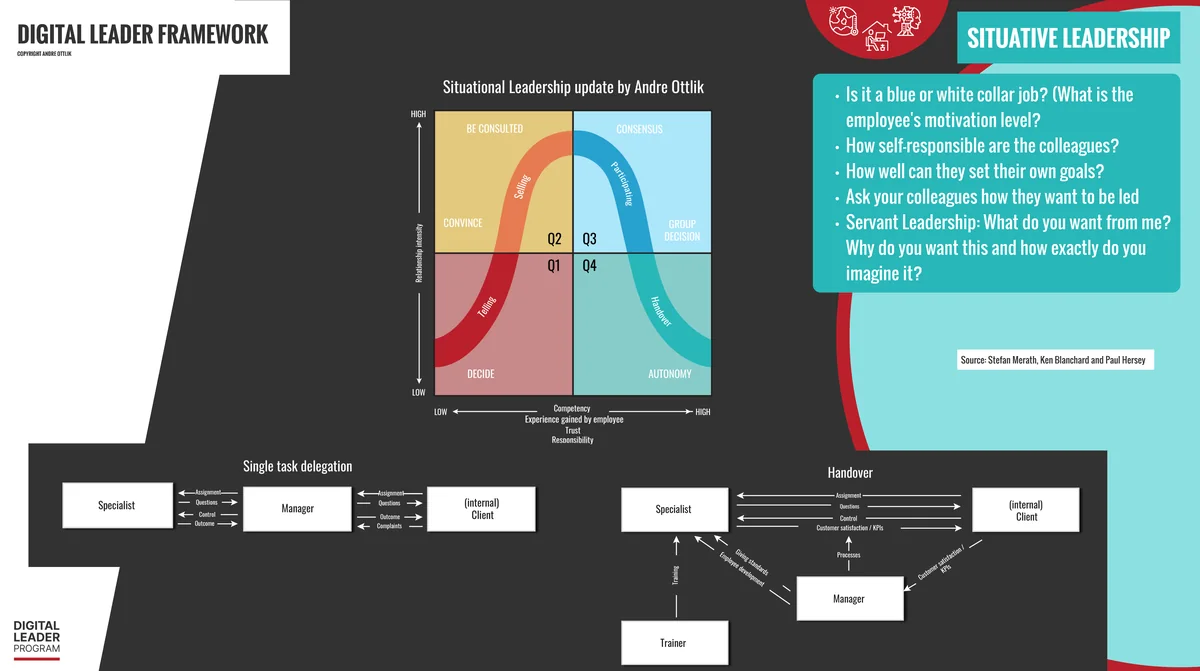
- Q1, telling: you decide. The person is new to the task. You give clear instructions.
- Q2, selling: you convince. The person is growing but still needs guidance. You explain the why, not just the what. You consult them, but you still steer.
- Q3, participating: you decide together. The person is competent and the relationship is strong. You look for consensus and co-create.
- Q4, handover: autonomy. High competence, high trust. The person owns the task, the process and the outcome.
The goal, following Ken Blanchard's One Minute Manager: the person at the lowest level who is capable of doing the job should do the job. Your job is to move as many topics as possible towards Q4.
One nuance most models miss: the quadrant depends on the task, not just the person. Someone can be fully autonomous in their core job and still be a beginner when you ask them to organise the company offsite. Every time you hand over something outside someone's core area, recalibrate.
From delegating a task to a real handover
Delegating a task and handing it over are two different things.
When you delegate a single task, you stay in the middle. The specialist comes to you with questions, you talk to the (internal) client, you control the outcome. You are still the bottleneck, just a slightly busier one.
When you hand over, the specialist works directly with the client. You step back into setting standards, processes and the person's development. Your role shifts from doing to enabling.
Why does this rarely happen in practice? Because a proper handover takes time: training the person, setting up the process, building trust. In Eisenhower's terms, handovers are important but not urgent, and that is exactly why they never get done. If you want an autonomous team, put the next handover in your calendar like any other important appointment.
Build the framework that allows mistakes
Autonomy needs clear guardrails. In the beginning it takes time to agree on rules, to establish a culture where mistakes are allowed, and to make your expectations explicit. Three things help:
- Clear goals and expectations. What should the result be, by when, and how will you both know it is done?
- Good and bad mistakes. Agree which mistakes you want more of, because they come from trying something new, and which ones need to be avoided. We use this exercise in culture workshops, and it works just as well in a single team meeting.
- Agreed check-ins. Not control at every step, but fixed moments to look at results together. Reliability works both ways: whoever owns a topic comes back proactively if something is going wrong, not when it is too late.
Ask your team how they want to be led
The fastest way to find the right quadrant is to ask. Questions we use with leaders:
- How self-responsible are your colleagues today, and how well can they set their own goals?
- How do they want to be led? Ask them directly.
- And in the spirit of servant leadership: What do you want from me? Why do you want this? And how exactly do you imagine it?
The trust question
Even if your colleague is perfectly prepared, none of it matters if you can't let go. The other person might be the best employee you have ever had, but as long as you can't give up control, they will never really be able to help you, and they won't grow.
So be honest with yourself: is the bottleneck really your team's competence, or your ability to trust?
What you gain
Once your team has got there, the benefits are large:
- You save time in the long run. Because your team works independently, you can focus on the really important topics. You finally have time for leadership.
- Initiative and creativity grow. Teams that find their own way to a goal learn to work in a solution-oriented way.
- Motivation rises. People who make their own decisions and take responsibility feel empowered and see a sense of purpose in their work.
- People feel valued. Lived autonomy shows respect, and that leads to higher satisfaction and loyalty.
If you want to go deeper into when to tell and when to coach, read Leadership style: when to tell, when to coach. In Leadership Essentials, the second session is about exactly this: leadership styles and change, and how to move your team from telling to handover.